
Mold remediation in North Brunswick: what to know
North Brunswick is a Middlesex County township in the Raritan Valley, directly south of New Brunswick. It was incorporated in 1798, and development there has been largely suburban, with 15,789 housing units counted in 2020.
The township is part of the Lawrence Brook watershed, a tributary of the Raritan River, and Farrington Lake, a reservoir on Lawrence Brook, borders it. Properties near the brook and lake can be exposed to higher groundwater and runoff after heavy storms, a common trigger for basement and crawl-space mold.
In newer subdivisions and townhome communities, mold more often traces to HVAC condensate, finished-basement waterproofing and roof or window leaks, while older homes closer to New Brunswick are more likely to have ageing plumbing and roofing. Humid New Jersey summers add routine condensation risk.
Mold conditions in North Brunswick
Common mold types in this area: Cladosporium (finished basements and window frames); Penicillium/Aspergillus (HVAC condensate and ductwork); Chaetomium (drywall and framing after slow leaks); Stachybotrys (basement framing after persistent water intrusion).
We serve Farrington Lake, North Brunswick Community Park, Rutgers Gardens (nearby) and the wider North Brunswick area across ZIP codes 08902.
Signs you need mold remediation
- Visible mold covering more than about 10 square feet — beyond a DIY-scale cleanup
- Musty odor or visible growth returning after a bleach or store-bought spray treatment
- Mold on porous material — drywall, insulation, carpet — that can't simply be wiped clean
- A documented moisture event (flood, chronic leak) with mold discovered afterward
- A written inspection protocol in hand and ready to act on
How we handle mold remediation in North Brunswick
Across MoldAct's markets the remediation process is the same standard — S520 — but the moisture source it's chasing differs by geography. In Baltimore and the older NJ housing stock, the source is usually chronic: ageing plumbing, foundations with failed or absent waterproofing, decades of intermittent seepage. In Miami, source correction more often means a single acute event — an HVAC condensate line, a balcony seal, a hurricane-season roof or window failure — but the fast climate means the window to act before Stachybotrys establishes (roughly 8-12 days of sustained wetting) is shorter.
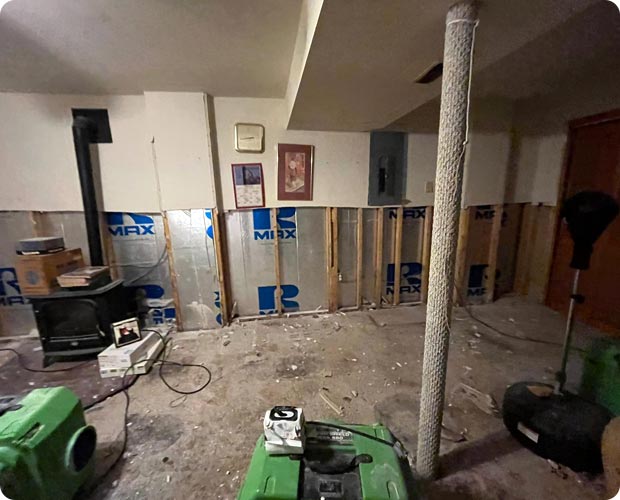
Source correction always comes first: remediating mold without fixing what's making it wet is remediation that will need to be repeated. From there, containment scales to the affected area — poly sheeting over a small localised area, or a full floor-to-ceiling barrier with negative air pressure (HEPA scrubbers) for larger or Condition 3 jobs.