
Mold inspection in Wynwood: what to know
Wynwood's industrial and warehouse buildings — many repurposed as art galleries, studios, and mixed-use spaces — have flat roofs and minimal insulation that create extreme attic and roof-deck heat and humidity, driving rapid mold growth after any roof membrane failure.
The neighbourhood's rapid gentrification has produced many renovation projects in buildings not remediated after historic flooding — mold discovered during demolition is common in older Wynwood industrial stock.
Mold conditions in Wynwood
Common mold types in this area: Aspergillus/Penicillium (flat-roof building interiors); Cladosporium (warehouse and studio interiors); Stachybotrys (unremediated historic flooding in older buildings).
We serve Wynwood Walls, Wynwood Garage, Wynwood Yard, NW 2nd Avenue arts district and the wider Wynwood area across ZIP codes 33127.
Signs you need mold inspection
- Visible discolouration or fuzzy growth on walls, ceilings, or around window frames
- A persistent musty odor, especially in a basement, crawl space, or HVAC closet
- A known past water event — a leak, flood, or slow plumbing failure — even if it was 'dried out' at the time
- Water staining, efflorescence, or bubbling paint on interior surfaces
- Allergy-type symptoms that improve when away from the property
How we handle mold inspection in Wynwood
MoldAct's three markets present three different moisture problems. Baltimore's brick rowhouses — most built between 1870 and 1940 on unreinforced foundations with no waterproofing membrane — see basement seepage as a near-universal condition, and the region's humid subtropical summers keep relative humidity above 70% for months at a time. In Newark and Jersey City, the same story plays out in century-old three- and four-family houses with original plumbing and unreinforced masonry. In Miami, the driver flips from ageing infrastructure to sheer climate: 70-90% relative humidity year-round means any building envelope failure or HVAC malfunction produces mold within 48-72 hours, in Art Deco-era buildings whose hollow-core block and plaster-over-lath construction hold moisture differently than modern drywall.
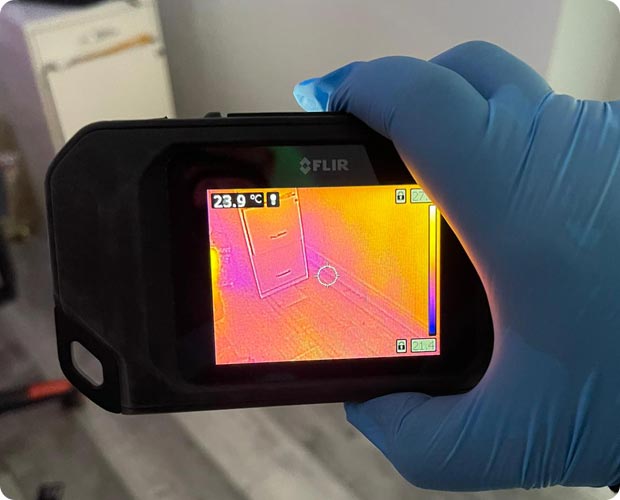
Because mold only grows where a water source, organic material, and warmth all converge, an inspection has to trace the moisture, not just photograph the visible growth. A licensed assessor uses moisture meters and thermal imaging to find wet material behind finishes, then collects air samples — always paired with a simultaneous outdoor sample, since an indoor spore count means nothing without that comparison point.