
Skip to content
Licensed mold remediation — call to schedule
ES
MoldAct logo MoldAct IICRC S520 Certified Mold Remediation
Certified technician conducting a mold inspection with moisture-mapping equipment inside a home

Mold Inspection in Columbia, MD

A professional mold inspection identifies the type, extent, and moisture source driving mold growth through visual survey, moisture mapping, and air or surface sampling by a licensed mold assessor — with a written remediation protocol included.

Get Your Free Mold Inspection

Or call now: (877) 660-0430

Mold inspection in Columbia: what to know

Columbia's planned community housing stock (1970s–1990s townhouses and single-family homes) has aging waterproofing and HVAC systems that are approaching end of service life, making water damage and mold increasingly common.

Many Columbia properties have finished basements — a major mold risk when the sump pump fails or the exterior waterproofing fails, as finished materials (drywall, carpet, dropped ceilings) create hidden mold cavities.

Mold conditions in Columbia

Common mold types in this area: Cladosporium (basement drywall); Penicillium/Aspergillus (carpet and insulation in finished basements); Stachybotrys (framing behind finished basement walls with chronic moisture).

We serve Merriweather Post Pavilion, Columbia Mall, Lake Kittamaqundi, Howard County General Hospital and the wider Columbia area across ZIP codes 21044, 21045, 21046.

Signs you need mold inspection

  • Visible dark or discoloured patches on walls, ceilings, or floors
  • Persistent musty or earthy odour in one or more rooms
  • Unexplained respiratory symptoms or allergic reactions indoors
  • Water stains, efflorescence, or swollen drywall
  • Recent water intrusion — roof leak, burst pipe, or flooding
  • Condensation on windows or cold surfaces in humid conditions
  • Peeling paint or wallpaper that is not explained by age

How we handle mold inspection in Columbia

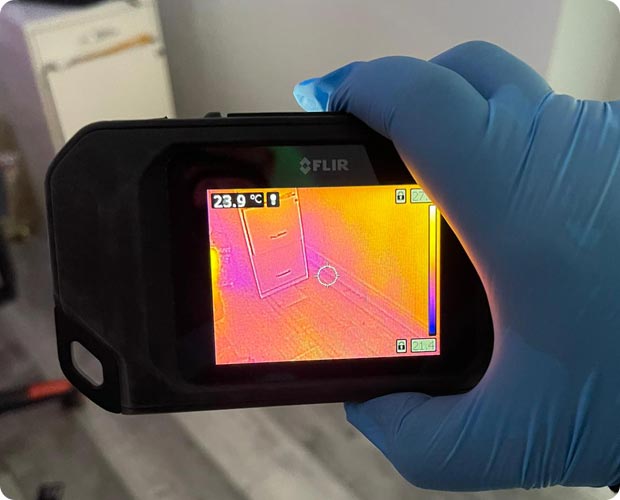
A mold inspection is the essential first step before any remediation work. A licensed mold assessor conducts a systematic visual survey of the property, uses moisture meters and thermal imaging to locate hidden wet areas, and collects air or surface samples where mold is suspected or confirmed. Samples are sent to an accredited AIHA laboratory for species identification and spore-count analysis.

Under the NYS 2015 Mold Law and analogous Florida and New Jersey regulations, the mold assessor and the mold remediator must be separate companies. This independence protects homeowners from inflated scopes and conflicts of interest. MoldAct works exclusively with licensed, independent assessors in each market.

Simple, transparent process

Our Columbia Mold Inspection Process

  1. 1

    Pre-inspection questionnaire

    We document the property history: past water events, known leaks, HVAC service dates, and any prior remediation. This guides the inspector to high-risk areas before they arrive on site.

  2. 2

    Visual survey and moisture mapping

    The assessor inspects all accessible areas including attic, crawl space, basement, bathrooms, and HVAC system using a calibrated moisture meter and, where indicated, a thermal imaging camera to detect hidden moisture behind walls or under floors.

  3. 3

    Air and surface sampling

    Air cassette samples are collected inside and outside the building simultaneously — the exterior sample is the baseline control. Surface swabs or tape-lift samples are taken from any suspected or confirmed mold growth. All samples are chain-of-custody shipped to an AIHA-accredited laboratory.

  4. 4

    Laboratory analysis

    The lab identifies mold species and reports indoor vs outdoor spore counts. Results are typically returned within 24–48 hours. Stachybotrys (black mold) requires specific identification because its spores are heavy and may not be fully captured in air samples — surface samples are critical for suspected Stachybotrys.

  5. 5

    Written remediation protocol

    The licensed assessor produces a formal written protocol specifying scope, containment method (Level I, II, or III per IICRC S520), HEPA requirements, personal protective equipment, and clearance criteria. This document is yours to use with any licensed remediator.

Mold Inspection in Columbia — FAQs

Do you provide mold inspection in Columbia?

Yes — MoldAct provides mold inspection throughout Columbia, MD (ZIP codes: 21044, 21045, 21046) and surrounding Maryland areas. Call us to book the earliest available appointment.

How much does a mold inspection cost?

A standard mold inspection with air sampling typically costs $300–$600 for a residential property, depending on size and number of samples. Properties requiring extensive thermal imaging or multiple sample locations may cost more. Always get a written quote that specifies what is included.

Can the mold inspector also do the remediation?

Not under the NYS 2015 Mold Law, and we recommend keeping assessment and remediation separate in all markets including NJ and FL. The assessor's written protocol is an independent document — the remediator follows it, and a separate post-remediation clearance test confirms the work is complete.

How long does a mold inspection take?

Most residential inspections take 1.5–3 hours on site, plus 24–48 hours for laboratory results. You receive the full written report including protocol within 48–72 hours of the site visit.

Do I need a mold inspection before buying a home?

Yes — particularly in Baltimore (older housing stock, known moisture issues), New Jersey (coastal humidity, Sandy legacy), and Miami (tropical climate). A mold inspection is distinct from a standard home inspection and should be performed by a licensed mold assessor, not a general home inspector.

Mold Inspection in Columbia — book today

Licensed, insured mold remediation contractors. Call to schedule.

Call Now Free Quote