
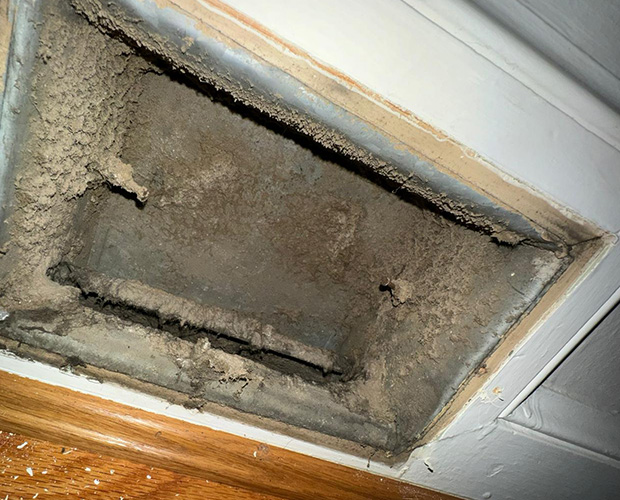
HVAC mold cleaning in Opa-locka: what to know
Opa-locka's distinctive Moorish Revival public buildings (1920s) and surrounding working-class residential stock have significant deferred maintenance issues — roof and building envelope failures are a common mold source.
The community's industrial areas and proximity to OPA-locka Executive Airport create mixed-use exposures — commercial buildings with inadequate HVAC capacity for industrial humidity loads are a recurring mold issue.
Mold conditions in Opa-locka
Common mold types in this area: Aspergillus/Penicillium (deferred maintenance buildings); Cladosporium (outdoor tropical background); Stachybotrys (chronically failed roof and envelope).
We serve Opa-locka City Hall (Moorish architecture), OPA-locka Executive Airport, Ali Baba Avenue, Sherbondy Village Park and the wider Opa-locka area across ZIP codes 33054, 33055.
Signs you need HVAC mold cleaning
- A musty or 'wet dog' smell when the HVAC system kicks on
- Visible mold or discolouration around a vent, air handler closet, or condensate line
- Water staining or dampness in a master-bath air handler closet
- Allergy-type symptoms that worsen specifically when the AC is running
- Recurring condensate line clogs or overflow
How we handle HVAC mold cleaning in Opa-locka
Standard duct cleaning and HVAC mold remediation are not the same service, and the distinction matters. If mold is confirmed inside ductwork or on an air handler coil, that's a mold remediation scope under S520 — assessment, containment appropriate to the space, and treatment of the affected components — not a routine duct-cleaning appointment.
This service shows up with very different footprints across MoldAct's three markets. In Little Havana and Doral's residential sections, HVAC condensate overflow near the master-bath air handler closet is one of the single most common mold sources in Miami's climate — the closet configuration traps condensate that overflows onto drywall and subfloor before anyone notices. In Brickell's high-rise towers, the exposure is structural: centralised HVAC systems serving entire buildings mean a single coil or drain-pan failure can distribute spores to dozens of units through shared air handling, which is a very different scale and liability picture than a single-family condensate closet.