
HVAC mold cleaning in Crofton: what to know
Crofton is a planned community in Anne Arundel County, west of Annapolis and centred on its golf-course roots. Much of its single-family and townhome stock dates from the 1960s onward, so many homes are now old enough for original roofs, flashing, window seals and below-grade waterproofing to be at or past their service life.
Many Crofton homes have basements or crawl spaces, and the area sits in the humid mid-Atlantic climate where summer relative humidity regularly runs high. Unconditioned crawl spaces and under-ventilated basements are common places for moisture and mold to build up quietly.
Heavily wooded lots and mature tree cover keep shaded roofs, siding and gutters damp for long stretches, and clogged gutters or poor grading near foundations are a frequent route for water into lower levels.
Mold conditions in Crofton
Common mold types in this area: Cladosporium (basement walls and window frames in 1960s–1980s homes); Penicillium/Aspergillus (HVAC condensate and ductwork in ageing systems); Chaetomium (framing and drywall after slow roof or plumbing leaks); Stachybotrys (sill plates and drywall after prolonged basement water intrusion).
We serve Crofton Country Club, Crofton Library (Anne Arundel County Public Library), Crofton Parkway and the wider Crofton area across ZIP codes 21114.
Signs you need HVAC mold cleaning
- A musty or 'wet dog' smell when the HVAC system kicks on
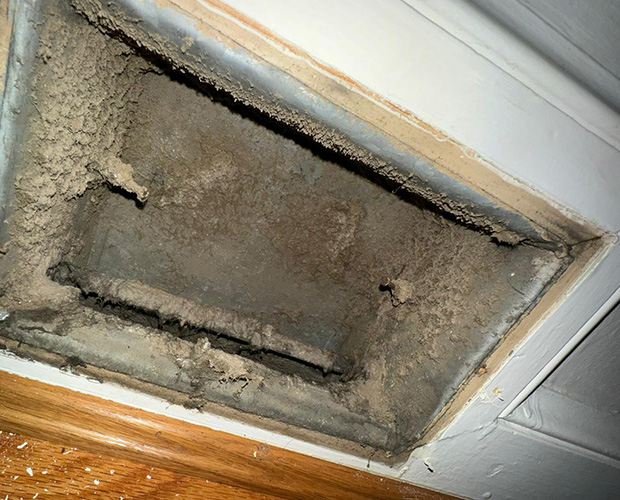
- Visible mold or discolouration around a vent, air handler closet, or condensate line
- Water staining or dampness in a master-bath air handler closet
- Allergy-type symptoms that worsen specifically when the AC is running
- Recurring condensate line clogs or overflow
How we handle HVAC mold cleaning in Crofton
Standard duct cleaning and HVAC mold remediation are not the same service, and the distinction matters. If mold is confirmed inside ductwork or on an air handler coil, that's a mold remediation scope under S520 — assessment, containment appropriate to the space, and treatment of the affected components — not a routine duct-cleaning appointment.
This service shows up with very different footprints across MoldAct's three markets. In Little Havana and Doral's residential sections, HVAC condensate overflow near the master-bath air handler closet is one of the single most common mold sources in Miami's climate — the closet configuration traps condensate that overflows onto drywall and subfloor before anyone notices. In Brickell's high-rise towers, the exposure is structural: centralised HVAC systems serving entire buildings mean a single coil or drain-pan failure can distribute spores to dozens of units through shared air handling, which is a very different scale and liability picture than a single-family condensate closet.