
Crawl space mold in Dundalk: what to know
If you're in Dundalk Village, you're in one of the country's earliest federally funded planned communities — built starting in the late 1910s to house shipyard workers, later expanded during WWII for the Bethlehem Steel Sparrows Point workforce. That century-plus-old housing stock shares the same fundamental vulnerability as DC's oldest rowhouses: masonry and wood-frame construction built long before any modern waterproofing membrane existed.
Dundalk's peninsula geography, surrounded by the Patapsco River and Chesapeake Bay tidal waters, means low-lying properties here carry a real, documented flood and groundwater risk that inland Baltimore County towns don't share to the same degree.
A lot of Dundalk's housing was built quickly and densely to house an industrial workforce on tight timelines during two different wartime expansions — that speed sometimes meant foundation and drainage work that was adequate for its era but hasn't aged as well as slower, more expensive construction elsewhere.
Mold conditions in Dundalk
Common mold types in this area: Chaetomium (century-old planned-community housing with original, unimproved drainage); Stachybotrys chartarum (peninsula flood and groundwater risk near the Patapsco and Chesapeake); Cladosporium (general background growth in dense, older duplex and rowhouse construction); Penicillium/Aspergillus (wartime-era construction with foundation shortcuts common to the period).
We serve Dundalk Village Historic District, Sparrows Point (former Bethlehem Steel site), Patapsco River, North Point State Park, Heritage Fair grounds and the wider Dundalk area across ZIP codes 21222.
Signs you need crawl space mold
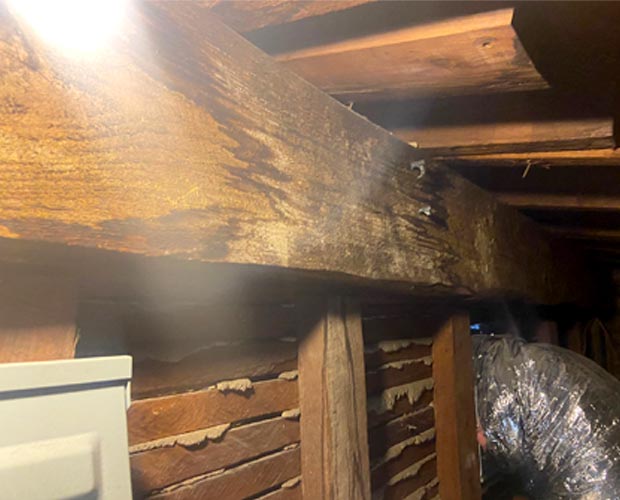
- Dark staining or fuzzy growth on floor joists or subfloor decking visible through the crawl-space access
- Musty odour rising from floor areas or floor registers
- Soft spots or springiness in floors above the crawl space
- Increased allergy or respiratory symptoms for ground-floor occupants
- Evidence of standing water, saturated soil, or moisture-damaged insulation in the crawl space
- Rust on metal fasteners, HVAC components, or pipes in the crawl space
How we handle crawl space mold in Dundalk
Crawl spaces are among the most neglected areas in residential construction and among the most common locations for extensive mold growth. Ground moisture vapour rises from unprotected soil, condenses on the cooler wood framing above, and creates the persistently humid environment that Cladosporium, Penicillium, Aspergillus, and Stachybotrys require to grow. In warm climates like Miami, humid outdoor air entering through vents creates the same problem.
Crawl space mold on floor joists and subfloor decking is particularly serious because it directly contacts the structural components that support the living areas above. Mold-colonised wood also experiences fungal decay (wood rot) over time, which can compromise structural integrity. Early remediation protects both air quality and structure.