
Crawl space mold in Cockeysville: what to know
If you're in Cockeysville, you're in an area historically known for limestone and marble quarrying — the same Cockeysville Marble used in the Washington Monument and U.S. Capitol — and that underlying limestone geology creates karst-like conditions in places, where groundwater can move through natural channels in the bedrock in ways that don't always follow the surface drainage you'd expect.
Housing here mixes older farmhouses and mid-century homes from the area's quarrying and agricultural past with newer suburban subdivisions built as Baltimore County's growth pushed north along the I-83 corridor — the older properties in particular may have foundation drainage that predates any awareness of the local karst geology.
If your basement takes on water in a pattern that doesn't match the obvious grading or gutter issues, it's worth asking whether the local limestone geology is routing groundwater differently than a standard soil-drainage assessment would predict.
Mold conditions in Cockeysville
Common mold types in this area: Stachybotrys chartarum (irregular groundwater movement through limestone/karst geology); Cladosporium (older farmhouse and mid-century foundation drainage); Penicillium/Aspergillus (newer suburban HVAC and interior humidity); Chaetomium (long-standing moisture in older agricultural-era buildings).
We serve Oregon Ridge Park, Hunt Valley (nearby), I-83 corridor, Ashland Nature area, Beaver Dam Swimming Club (nearby) and the wider Cockeysville area across ZIP codes 21030.
Signs you need crawl space mold
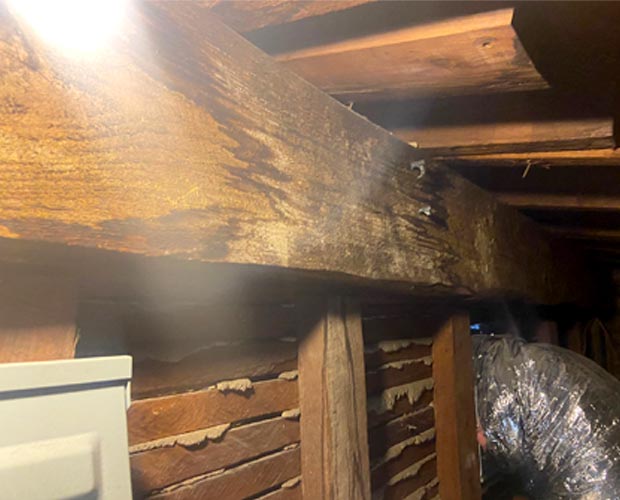
- Dark staining or fuzzy growth on floor joists or subfloor decking visible through the crawl-space access
- Musty odour rising from floor areas or floor registers
- Soft spots or springiness in floors above the crawl space
- Increased allergy or respiratory symptoms for ground-floor occupants
- Evidence of standing water, saturated soil, or moisture-damaged insulation in the crawl space
- Rust on metal fasteners, HVAC components, or pipes in the crawl space
How we handle crawl space mold in Cockeysville
Crawl spaces are among the most neglected areas in residential construction and among the most common locations for extensive mold growth. Ground moisture vapour rises from unprotected soil, condenses on the cooler wood framing above, and creates the persistently humid environment that Cladosporium, Penicillium, Aspergillus, and Stachybotrys require to grow. In warm climates like Miami, humid outdoor air entering through vents creates the same problem.
Crawl space mold on floor joists and subfloor decking is particularly serious because it directly contacts the structural components that support the living areas above. Mold-colonised wood also experiences fungal decay (wood rot) over time, which can compromise structural integrity. Early remediation protects both air quality and structure.