
Crawl space mold in Accokeek: what to know
Accokeek is a rural-suburban community in southern Prince George's County on the Potomac River, bordering Charles County and served by Maryland Route 210 (Indian Head Highway).
Much of the area is wooded, low-density residential land. West of Route 210, the Moyaone Reserve is described as mid-century, individually designed homes on wooded lots of five acres or more. Homes on lots like these commonly have crawl spaces or basements, so drainage and plumbing leaks can go unnoticed for a long time.
Heavy tree cover and the nearby Potomac shoreline and creek valleys keep shaded roofs, siding and lower levels from drying out quickly, and the hot, humid mid-Atlantic summers add routine condensation risk to unconditioned crawl spaces.
Mold conditions in Accokeek
Common mold types in this area: Cladosporium (crawl-space and basement surfaces); Penicillium/Aspergillus (HVAC condensate and ductwork); Chaetomium (framing and drywall after slow roof or plumbing leaks); Stachybotrys (basement framing after persistent water intrusion).
We serve Piscataway Park, National Colonial Farm, Hard Bargain Farm and the wider Accokeek area across ZIP codes 20607.
Signs you need crawl space mold
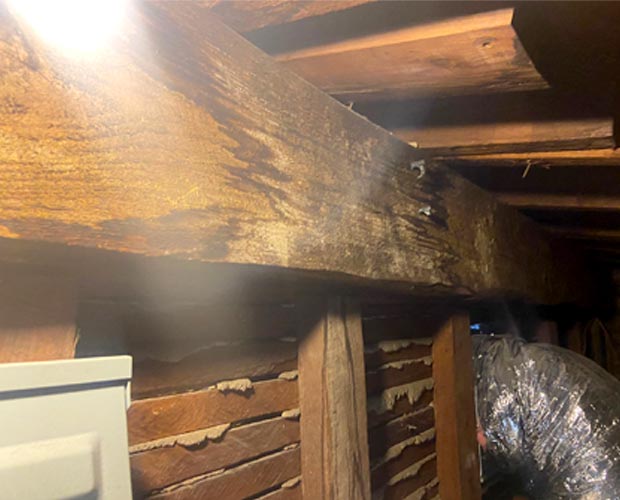
- Dark staining or fuzzy growth on floor joists or subfloor decking visible through the crawl-space access
- Musty odour rising from floor areas or floor registers
- Soft spots or springiness in floors above the crawl space
- Increased allergy or respiratory symptoms for ground-floor occupants
- Evidence of standing water, saturated soil, or moisture-damaged insulation in the crawl space
- Rust on metal fasteners, HVAC components, or pipes in the crawl space
How we handle crawl space mold in Accokeek
Crawl spaces are among the most neglected areas in residential construction and among the most common locations for extensive mold growth. Ground moisture vapour rises from unprotected soil, condenses on the cooler wood framing above, and creates the persistently humid environment that Cladosporium, Penicillium, Aspergillus, and Stachybotrys require to grow. In warm climates like Miami, humid outdoor air entering through vents creates the same problem.
Crawl space mold on floor joists and subfloor decking is particularly serious because it directly contacts the structural components that support the living areas above. Mold-colonised wood also experiences fungal decay (wood rot) over time, which can compromise structural integrity. Early remediation protects both air quality and structure.