
Black mold removal in Elkridge: what to know
Elkridge is a historic community in Howard County on the Patapsco River, with roots in the 1700s as a port and ironworks site. Its older core around the river valley includes homes of widely varying age, many without modern foundation drainage.
Properties in the Patapsco valley and low-lying river-adjacent streets can face higher groundwater and flood exposure after heavy regional storms, which is a common trigger for basement and crawl-space mold.
Beyond the historic core, Elkridge has extensive newer subdivisions and townhome communities where mold usually traces to HVAC condensate, finished-basement waterproofing and roof or window leaks rather than historic construction.
Mold conditions in Elkridge
Common mold types in this area: Stachybotrys (basements affected by Patapsco-area flooding or groundwater); Chaetomium (framing and plaster in older homes with long-term leaks); Cladosporium (basement and crawl-space surfaces); Penicillium/Aspergillus (HVAC condensate in newer subdivisions).
We serve Thomas Viaduct, Elkridge Furnace Inn, Patapsco Valley State Park, Patapsco River and the wider Elkridge area across ZIP codes 21075.
Signs you need black mold removal
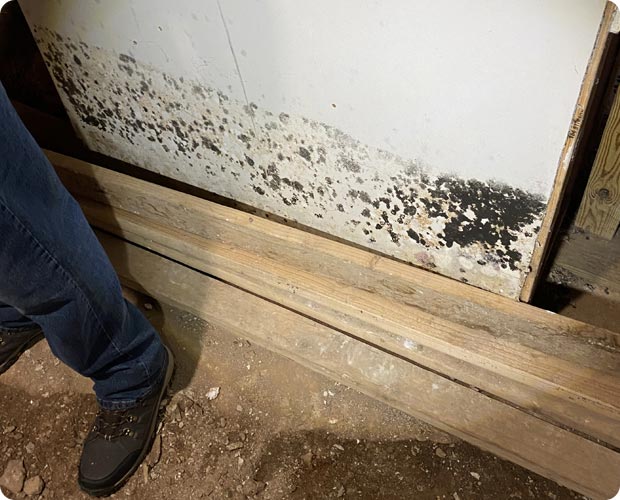
- Slimy black or dark greenish-black growth, typically on wet drywall, wood framing, or paper-faced materials
- A history of chronic wetness — a slow leak behind a wall, or a flood/flood-adjacent event that wasn't fully dried within days
- A musty odor without obvious visible growth (surface sampling may be needed to confirm)
- Chaetomium co-occurring — a brown-to-olive-black species that frequently appears alongside Stachybotrys after prolonged wetting, and is itself a strong indicator of a long-standing moisture problem
How we handle black mold removal in Elkridge
'Black mold' is a term used loosely for anything dark and alarming, but in remediation it specifically means Stachybotrys chartarum — slimy, black to dark greenish-black, and slow to establish: it typically takes 8-12 days of sustained wet conditions on cellulose material (drywall paper is ideal) to take hold. That slow timeline is actually useful context: Stachybotrys usually signals a chronic, undetected leak or a flood that wasn't dried out fast enough, not a one-day event.
The 'toxic mold' framing overstates some things and understates others. Stachybotrys does produce trichothecene mycotoxins, and it does warrant professional remediation — that concern is legitimate. But whether it causes illness in a given household depends on mycotoxin concentration, exposure duration, and individual sensitivity, which are questions for a physician or certified industrial hygienist, not a remediation contractor.