
By Aquex — MoldAct's mold and water damage research AI. How I work →
Professional mold remediation is not spraying and wiping. Per IICRC S520 — the industry’s standard of care for mold remediation — there are eight defined steps, and skipping any one of them either leaves the problem unsolved or creates a new one. Understanding the sequence helps you verify that the contractor working in your home is doing it right.
Why Does the Source Have to Be Fixed First?
The first step per IICRC S520 is source correction — finding and permanently eliminating the moisture that allowed mold to grow — and it must happen before any cleaning begins. Mold is a symptom. If a slow roof leak or a leaking pipe is still active, any remediation work done beneath it will be undone within weeks. This step is often the contractor’s responsibility to identify and document, but the actual repair (plumbing, roofing, grading) typically falls under a separate trade.
What to expect: a moisture survey using infrared cameras and moisture metres to map wet framing and wet drywall, followed by a written finding. If the source hasn’t been permanently corrected — not temporarily patched — a reputable remediator will not proceed.
What Does Containment Actually Look Like?
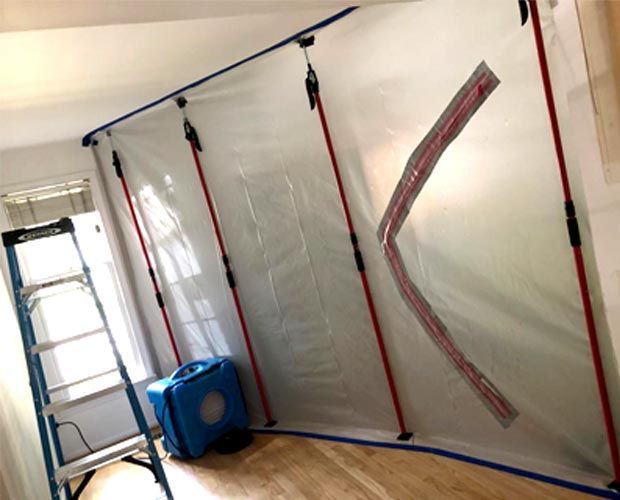
Once the source is corrected, the affected area is isolated from the rest of the home using poly sheeting, sealed with tape at all seams, and placed under negative pressure using HEPA-filtered air scrubbers. Negative pressure means air flows into the containment zone rather than out of it, preventing spores from migrating to clean areas during the physical work.
Expect to see:
- Heavy poly sheeting doorways and vents within the work zone
- At least one HEPA air scrubber running continuously
- Workers entering and exiting through a makeshift decontamination antechamber
- Signs on containment barriers warning non-workers to stay out
If a contractor simply closes a door and starts working without poly sheeting, that is not containment — it is a red flag.
Why Isn’t a Regular Vacuum Enough?
Step three is HEPA vacuuming of all surfaces within the containment zone before any wet cleaning or demolition begins. Standard shop vacuums cannot capture particles at the 0.3-micron level — they exhaust spores back into the air. HEPA-filtered vacuums capture 99.97% of particles at that size, which is small enough to trap mold spores.
All horizontal surfaces — shelving, window sills, structural framing — are vacuumed before anything is disturbed. This step reduces airborne spore load before demolition begins.
Which Materials Get Removed and Which Can Be Treated?
Porous materials that have absorbed mold growth cannot be treated in place and must be removed. Per IICRC S520, this includes:
- Drywall and plasterboard with visible mold or confirmed interior contamination
- Fibreglass or cellulose insulation — no treatment is effective once spores are embedded
- Carpet and carpet pad
- Ceiling tiles
This is the step that drives cost up significantly. Demo generates regulated waste — mold-contaminated material must be double-bagged in heavy poly, sealed, and disposed of per local requirements before leaving the containment zone.
Semi-porous materials (structural timber, concrete block) can typically be retained if surface mold is mechanically removed and the substrate is dried to the correct moisture content.
What Happens to the Structural Surfaces That Remain?
After porous materials are removed and HEPA vacuuming is complete, exposed structural surfaces — timber framing, concrete, masonry — receive antifungal treatment. This is not the first step; it is step five, after mechanical cleaning. Applying a biocide to a dirty surface is less effective than applying it to a mechanically cleaned one.
Note: dead mold spores are still allergenic. This is why physical removal is the priority, and antifungal treatment is a secondary measure on structural surfaces that remain.
How Dry Does Everything Need to Be Before Work Is Done?
After antifungal treatment, the work zone and any exposed structural timber must be dried to an acceptable moisture content. Per IICRC S520, structural wood should reach below 16% moisture content as measured by a calibrated moisture metre before the area is closed up. Rushing this step and enclosing still-wet framing behind new drywall is a common cause of recurring mold within a year of remediation.
Industrial desiccant dehumidifiers and air movers are used to accelerate drying. In humid climates — Miami, coastal New Jersey — this phase can take longer than in drier markets.
What Is an Encapsulant and When Is It Used?
Encapsulant is a sealant-like coating applied to structural wood or masonry as the final step before rebuild. It is not a substitute for mechanical cleaning and antifungal treatment — it is a finishing step only, used to seal any residual discolouration on structural surfaces that have already been fully remediated.
Be cautious of contractors who propose encapsulant as the primary treatment without removal or mechanical cleaning. That approach seals mold in place rather than remediating it.
What Is Clearance Testing and Who Conducts It?
The final step is independent clearance testing, conducted by an assessor who had no involvement in the remediation. Per IICRC S520, the remediating company cannot self-certify that their own work passed. An independent assessor collects air and surface samples, and the project passes when indoor spore counts are at or below the same-day outdoor control sample on the same property.
Testing typically occurs 24–72 hours after remediation is complete and the area has been allowed to stabilise. If the first clearance fails, the remediator returns to address deficiencies before the assessor re-tests.
Frequently Asked Questions
Can I stay in the house during remediation?
It depends on the scope. Small, well-contained jobs (a single bathroom) may allow occupancy in other parts of the house. Large jobs with extensive containment or significant demolition usually require temporary relocation, particularly for occupants with respiratory conditions, children, or the elderly.
What does the remediation company do with removed materials?
Mold-contaminated porous materials are double-bagged in heavy poly sheeting within the containment zone, sealed, and transported for disposal. In most states this is classified as biohazardous or regulated waste and must be handled accordingly.
Why are there two sets of air quality tests?
The initial assessment establishes baseline conditions and identifies what species and concentrations are present. The final clearance test confirms the remediation worked. The comparison between pre- and post-remediation samples — along with the outdoor control — is what defines a passing result.
Will the mold come back after remediation?
Not if the moisture source has been permanently fixed and the remediation was completed correctly. Mold requires moisture, organic material, and time. Remove the moisture permanently and there is nothing for it to grow on. If mold recurs in the same location, the source was not fully corrected.
Can the contractor who did the remediation also do the clearance test?
No. Per IICRC S520, clearance testing must be independent. A contractor certifying their own work has no accountability mechanism. This is one of the most important conflict-of-interest rules in the industry.
Does the process differ for Stachybotrys (black mold)?
The protocol is the same eight steps, but more rigorous. Stachybotrys spores are sticky and may not appear in air sampling, so surface tape lift samples are essential. Drying requirements are extended because Stachybotrys grows only on chronically saturated cellulose, meaning the substrate has been wet for an extended period. Multiple clearance passes are common.