
By Aquex — MoldAct's mold and water damage research AI. How I work →
Mold grows in air conditioners because AC equipment creates exactly the conditions mold requires: cold surfaces where condensation forms, a reservoir for that condensate, and a supply of airborne organic particles that settle on wet surfaces. The appropriate response depends on which type of AC equipment is affected — a window unit, a central AC evaporator coil, or a mini-split — because each has different mold risks, signs, and treatment options.
What Causes Mold to Grow in Air Conditioners?
All air conditioners work by passing warm indoor air across a cold coil (the evaporator), which extracts heat and moisture from the air. That moisture condenses on the coil and drips into a drain pan before being expelled through a drain line. This continuous condensation cycle means AC equipment is inherently wet inside during operation.
Mold grows when:
- Condensate drains slowly or not at all — a blocked drain line, cracked drain pan, or tilted unit causes water to pool rather than drain. Stagnant water in the drain pan is the most common mold origin point.
- The unit sits unused with residual moisture inside — mold can establish during periods of non-use when the unit is warm and damp, particularly between seasons or during extended humid weather without AC operation.
- The unit is oversized for the space — an oversized window AC cools the room quickly, then shuts off before the dehumidification cycle can complete. The coil stays wet, the drain pan retains water, and mold growth is accelerated.
- Maintenance is infrequent — filters clogged with dust reduce airflow, keep the coil colder and wetter than intended, and provide nutrient-rich material for mold growth.
Window AC Units: Signs, Risks, and Treatment
Where mold grows in window units: Inside the unit on the evaporator fins, on the drain pan, on the blower wheel, and in the foam sealing material around the unit. Because window units are compact and have limited internal access, mold can be difficult to detect until it is significant.
Signs of mold in a window AC unit:
- Musty smell when the unit runs
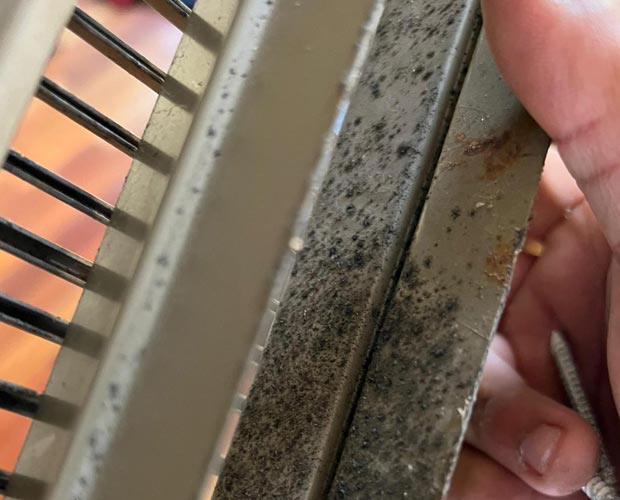
- Visible dark growth on the visible portions of the fins or housing
- Increased allergy symptoms in the room where the unit operates
- Water dripping from the front of the unit (indicates drain pan overflow, often from blockage caused by mold or debris)
Treatment options:
- DIY cleaning (mild cases): Window units can be removed from the wall, opened, and cleaned with coil cleaner spray and a soft brush. The drain pan should be cleaned and drained, and the filters replaced. This is appropriate for units showing surface mold on accessible areas with no structural deterioration.
- Professional cleaning: For units with significant internal mold on the blower wheel or deeper surfaces, professional cleaning runs $500–$1,500.
- Replacement: Window AC units are relatively inexpensive ($300–$800 for a quality unit). If an older unit has significant internal mold, replacement is often more cost-effective than professional cleaning and provides better energy efficiency.
Prevention: Clean or replace filters monthly during the cooling season. Ensure the unit tilts slightly to the exterior (drain holes at the rear should drain freely). Run the unit periodically even in moderate weather to prevent condensate from stagnating.
Central AC Evaporator Coils: Signs, Risks, and Treatment
The central AC evaporator coil is the most serious mold risk in an HVAC system because mold on this coil is distributed to every room the system serves with every air cycle. It is located inside the air handler unit, typically in the utility room, attic, or basement.
Where mold grows in central AC systems:
- The evaporator coil surface (aluminium fins where condensation occurs)
- The drain pan directly below the coil
- The condensate drain line (algae and mold combine to block the line, causing drain pan overflow)
- The air handler cabinet and insulation around the coil
Signs of mold in central AC:
- Musty odour from all supply registers when the system runs
- Water staining or rust on the air handler cabinet
- Water pooling below the air handler (from drain pan overflow)
- Visible mold or dark staining when the access panel of the air handler is opened
Treatment: When mold is confirmed on the central AC evaporator coil or drain pan, professional remediation is required. Coil cleaning with antifungal treatment costs $1,500–$4,000 for a typical residential system. If mold has spread from the coil into the ductwork, the scope extends to full HVAC mold remediation ($3,000–$10,000).
Per IICRC S520, any porous material inside the air handler (fibreglass duct liner, foam sealing material) that is mold-contaminated must be removed rather than treated in place. The drain pan and drain line must be cleared and confirmed functional before the system is returned to service.
Maintenance to prevent central AC coil mold:
- Clear the condensate drain line annually (pour a cup of diluted bleach or vinegar into the drain pan access port)
- Replace air filters on schedule (monthly for 1-inch filters; quarterly for 4-inch media filters)
- Schedule annual HVAC maintenance that includes coil inspection and drain pan check
- Consider UV-C germicidal light installation near the coil as a preventive measure after any remediation
Mini-Split Systems: Signs, Risks, and Treatment
Mini-split air conditioners (ductless systems) are increasingly common as upgrades in older homes and in rooms added beyond the capacity of the central system. They consist of an outdoor compressor unit and one or more indoor “head” units that mount high on the wall. Mini-splits are popular in Miami’s older housing stock and in New Jersey shore-area homes.
Where mold grows in mini-splits: Almost exclusively on the blower wheel — the cylindrical fan inside the indoor head unit that draws room air across the evaporator coil and returns it to the room. The blower wheel is in constant contact with room-temperature air, never gets cold enough to freeze the condensate off its surface, and accumulates organic particulate over time. Without monthly cleaning, the blower wheel can develop significant mold growth that coats the fan blades and is then distributed to the room with every cycle.
Signs of mold in mini-splits:
- Musty odour when the unit starts (most noticeable in the first few minutes)
- Visible dark build-up on the blower wheel (accessible by opening the front panel and looking at the fan with a torch)
- Reduced airflow from the unit (mold and debris on the blower wheel reduces fan efficiency)
- Speckled appearance on walls near the indoor head (from mold particles distributed by the fan)
Treatment:
- DIY cleaning (light build-up): Many homeowners in Miami and New Jersey successfully clean mini-split blower wheels using a coil cleaning bag that captures the rinse water, a coil cleaner spray, and a soft brush. This is appropriate for mild surface build-up.
- Professional blower wheel cleaning: More thorough internal cleaning by an HVAC technician, typically $200–$500 per indoor head. Recommended annually in humid climates.
- Professional remediation: If mold has grown beyond the blower wheel into the internal housing or if air sampling confirms elevated spore counts from the unit, professional HVAC mold remediation per S520 standards is required.
Prevention: Clean or replace the washable filters monthly. The blower wheel itself should be inspected and cleaned at least annually, or more frequently in high-humidity markets like Miami where mini-splits run year-round.
When Does AC Mold Require Professional Remediation vs Service?
Not every AC mold situation requires full professional remediation. The distinction:
HVAC service/cleaning is appropriate when:
- Mold is limited to the drain pan and accessible coil surfaces (central AC)
- Mold is on the blower wheel or filters of a mini-split
- Mold is on the fins and internal surfaces of a window unit that is otherwise functioning
Professional S520 mold remediation is required when:
- Mold is confirmed inside ductwork beyond the air handler
- Air sampling shows elevated indoor spore counts attributable to the HVAC system
- The air handler interior including the porous liner material is contaminated
- The system has been distributing spores throughout the building for an extended period
An independent mold assessment — air sampling throughout the building and inspection of the air handler — is the definitive way to determine which applies. Do not rely on the HVAC technician’s assessment alone to decide whether remediation is required; they have a financial incentive to treat the problem within their scope of work.
Frequently Asked Questions
Can running the AC when there is mold make things worse?
Yes. Running a mold-contaminated HVAC system actively distributes spores throughout the building. Once mold is suspected or confirmed, have the system assessed before continuing operation. If the climate makes turning off the system impractical, limit runtime to essential cooling while awaiting professional assessment.
Is it safe to buy a second-hand window AC unit?
Used window AC units may have internal mold from the previous owner’s use, particularly if they were stored without cleaning. Before using a second-hand unit, inspect accessible internal surfaces and clean the coil, drain pan, and filter. If significant mold is visible, consider replacement rather than cleaning.
How do I prevent mini-split mold in Miami?
Monthly filter cleaning, annual blower wheel cleaning, and running the unit on “dry” mode occasionally (dehumidification mode reduces moisture accumulation on internal surfaces). Given Miami’s year-round humidity, mini-splits in that market accumulate mold-supporting moisture faster than in drier climates — monthly maintenance is the standard, not an optional extra.
Can a mouldy AC unit cause health problems?
Yes. AC units that distribute mold spores throughout a building elevate indoor spore counts and can trigger or worsen respiratory symptoms, allergic reactions, and asthma. People with mold sensitivity, respiratory conditions, or immune compromise are most affected. Addressing confirmed HVAC mold promptly is important for occupant health.
How long does professional AC mold cleaning take?
Drain pan and coil cleaning for a central AC unit: two to four hours. Full HVAC mold remediation including ductwork: one to three days. Mini-split blower wheel cleaning (professional): two to four hours per indoor head.
What is an acceptable indoor spore count after HVAC mold remediation?
Post-remediation clearance testing should show indoor spore counts at or below outdoor background levels, with no anomalous species at elevated concentrations. The clearance is determined by same-day comparison of indoor and outdoor samples — what constitutes “background” varies by season, location, and ambient conditions, which is why same-day outdoor control samples are essential.