
By Aquex — MoldAct's mold and water damage research AI. How I work →
DIY mold removal is appropriate for a narrow set of situations: isolated surface mold under 10 sq ft on non-porous or semi-porous surfaces, where the moisture source is already corrected and there is no reason to suspect the problem extends behind walls. In every other scenario — larger patches, mold inside wall cavities, Stachybotrys, post-flood, or HVAC involvement — calling a professional is both safer and ultimately less expensive. The reason DIY fails in complex situations is not effort; it is the absence of HEPA containment, proper equipment, and independent clearance verification.
When Is DIY Mold Removal Acceptable?
The widely cited threshold is 10 sq ft of isolated, visible surface mold in a single contiguous area. This is the guideline used by the US Environmental Protection Agency and is consistent with IICRC S520’s condition categories — at this scale, with the right precautions, the risk of spreading contamination to unaffected areas is manageable for a careful homeowner.
Suitable DIY scenarios:
- Surface mold on bathroom tile grout, a bathroom ceiling, or the exterior of a window frame
- Visible Cladosporium (dark surface spots) on a semi-porous surface like concrete block
- Mold on a small section of bathroom drywall where the moisture source (a dripping tap, poor ventilation) is corrected and the problem clearly does not extend into the wall cavity
What proper DIY looks like:
- Fix the moisture source first — without this step, the mold will return regardless of how thoroughly you clean
- Wear an N95 respirator rated for mold (not a standard dust mask), nitrile gloves, and eye protection
- Use a HEPA vacuum on the surrounding area before wet cleaning to capture loose spores
- Clean with an appropriate antifungal cleaner — do not rely on bleach alone on porous surfaces, as it does not penetrate
- Double-bag all waste in heavy poly bags and seal before removing from the area
- Do not use a standard shop vacuum at any point — it exhausts spores back into the air
DIY without these precautions is not safer than doing nothing. Without an N95 and some basic containment (at minimum, closing off adjacent rooms), you risk spreading spores to clean areas of the home during cleaning.
When Should You Call a Professional?
The answer is immediate in any of these situations:
Area exceeds 10 sq ft. The 10 sq ft threshold exists because beyond it, the probability of hidden growth and the risk of cross-contamination during removal increase significantly. A 20 sq ft patch on a bathroom wall may indicate a much larger growth behind the tile that is only visible at the surface.
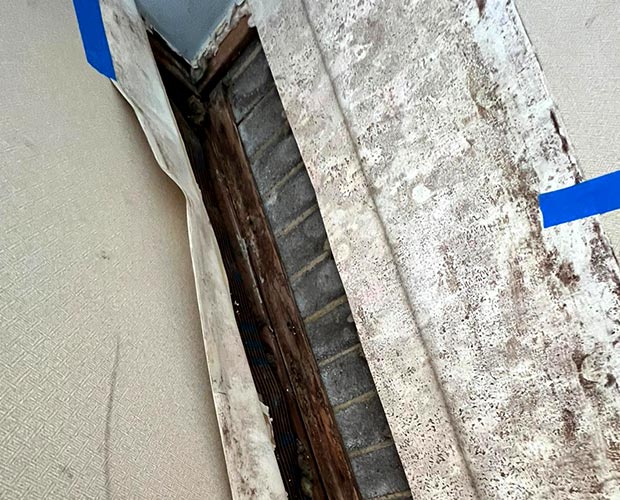
Mold is behind walls or in a wall cavity. Any mold that appears to have originated inside a wall — discolouration at wall seams, a musty smell with no visible surface source — requires professional assessment. Opening a wall without proper containment and HEPA equipment spreads spores through the entire home.
Stachybotrys is present or suspected. Stachybotrys (black mold on chronically wet drywall or timber) is not a DIY project. Its spores are sticky and won’t travel easily through the air, so you may not be redistributing them by working — but the substrate is likely saturated, the growth likely extends further than the visible surface, and per IICRC S520 the protocol requires mechanical removal, extended drying, and independent clearance testing that DIY cannot provide.
Post-flood remediation. Any flooding that has left building materials wet for more than 24–48 hours creates conditions for mold growth beyond the scope of DIY. Post-flood remediation involving Stachybotrys in a full basement is priced at $15,000–$50,000+, reflecting the true scope of the work.
HVAC involvement. Mold in a duct system or on HVAC coils requires professional cleaning with HEPA equipment and source correction. Running a contaminated HVAC system while attempting DIY cleaning distributes spores to every room the system serves.
Occupants with health sensitivities. If anyone in the household has respiratory conditions, is immunocompromised, is pregnant, or is an infant or elderly person, professional remediation with proper containment is the appropriate standard even for jobs that might otherwise qualify for DIY.
Why Does DIY Fail in Complex Situations?
The three failure modes of DIY remediation in complex situations:
No HEPA containment. Professional remediation uses poly sheeting, sealed with tape, to isolate the work zone from the rest of the home, combined with HEPA air scrubbers running under negative pressure. Without this, physical disturbance of mold during removal sends spores airborne throughout the property. Elevated spore counts in rooms well away from the original mold location are a common finding after uncontained DIY attempts.
No HEPA vacuuming. Standard shop vacuums cannot trap particles at the 0.3-micron level. They capture bulk debris and exhaust fine spores back into the air. Every surface in the work zone should be HEPA-vacuumed before wet cleaning begins — this step is not achievable without the right equipment.
No independent clearance. Even a successful professional job requires independent clearance testing before it is considered complete per IICRC S520. DIY work has no verification mechanism. You may believe the problem is resolved when elevated spore counts remain in the structure.
What Does a DIY Job Actually Cost Versus a Professional One?
For a legitimate small DIY job under 10 sq ft:
- N95 respirator: $15–$30
- Nitrile gloves: $10
- Antifungal cleaner: $20–$40
- HEPA vacuum rental (if you don’t own one): $50–$80/day
- Poly sheeting and tape for area isolation: $20–$30
Total: $100–$200 for a properly equipped DIY attempt on a small surface patch.
For a professional job covering the same area: $500–$1,500 including containment and clearance testing.
The DIY saving is real for a genuine small-surface job. The calculus reverses immediately for anything behind walls or larger — a failed DIY attempt that spreads contamination through a home can convert a $5,000 problem into a $20,000 one.
Frequently Asked Questions
Can I use bleach to kill mold?
Bleach kills surface mold on non-porous materials like tile and glass, but does not penetrate porous surfaces (drywall, grout, timber). On porous materials, bleach kills surface cells but leaves the hyphae (the root structure) intact and does not prevent regrowth. Dead mold spores are also still allergenic. Bleach has a limited role in surface-level mold treatment; it is not a substitute for physical removal on porous materials.
Is mold testing necessary before I clean a small patch myself?
Not always. If the visible mold is clearly on a non-porous surface, the moisture source is obvious and correctable, and the area is under 10 sq ft, professional testing before DIY cleanup is probably not necessary. Testing becomes important when: the source is unclear, you suspect hidden growth, the mold is returning despite prior cleaning, or you want documentation for insurance or real estate purposes.
What respirator do I need for DIY mold work?
An N95 respirator rated for particulates — not a standard dust mask, which does not seal adequately or filter at the required particle size. For larger DIY jobs near the 10 sq ft limit, a half-face respirator with P100 cartridges provides better protection. Disposable N95s are adequate for small, one-off tasks.
If I clean it myself, how do I know it worked?
You don’t, without clearance testing. Independent clearance testing costs $400–$800 per visit and is the only objective measure of whether mold counts have returned to acceptable levels. For a small DIY job on a non-porous surface with an obvious and corrected moisture source, the risk of residual contamination is low. For anything larger or on porous materials, post-cleanup testing is worth the cost.
Is “mold killer” spray from a hardware store effective?
These products are registered biocides that will kill mold cells on contact. What they do not do: penetrate porous materials, remove dead spores (which are still allergenic), or address the underlying moisture. They are appropriate as a supporting step after mechanical cleaning of non-porous surfaces — not as a standalone treatment.
What if the mold keeps coming back after I clean it?
Recurring mold after cleaning is almost always a sign that the moisture source has not been permanently corrected. Mold doesn’t spontaneously appear on dry surfaces. If growth returns in the same location after a cleaning, the moisture is still active — whether that’s a hidden pipe drip, chronic condensation, or groundwater intrusion. At this point, a professional assessment is warranted.