
By Aquex — MoldAct's mold and water damage research AI. How I work →
Bathroom mold removal ranges from a straightforward surface cleaning job to a full structural remediation, and the difference matters enormously in terms of cost, scope, and whether the problem will return. Surface mold on tile, grout, and caulk is typically Cladosporium — a common allergen that a ventilation fix and antifungal cleaning can resolve. Mold inside the drywall, cement board, or framing behind the tiles is a structural problem requiring professional remediation per IICRC S520, with full containment, material removal, and independent clearance testing.
How Do You Tell Surface Mold from Structural Contamination?
The distinction is critical because treating surface mold when the problem is actually structural will produce temporary results at best — the mold returns within weeks of cleaning because the source is hidden behind the tile or wall.
Signs you are dealing with surface mold only:
- Mold is visible on tile faces, grout lines, and caulk but the wall feels solid and dry to the touch
- Mold appeared relatively recently and there is no history of plumbing leaks
- The discolouration cleans off with antifungal treatment and does not return within a few weeks of improved ventilation
- No musty odour when the bathroom door is closed and unventilated
Signs of structural contamination:
- A persistent musty odour even after surface cleaning — the smell is coming from behind the wall
- Soft, spongy, or discoloured drywall around the shower surround or tub
- Tiles that feel hollow when tapped (adhesive failure from moisture-damaged substrate)
- Grout or caulk that keeps growing mold within weeks of cleaning, even with improved ventilation — this signals moisture behind the surface
- A visible bulge or staining on the wall or ceiling near the shower
- History of a slow shower pan leak, cracked grout that allowed water penetration, or a pipe behind the wall that has dripped
What Is the Right Approach to Surface Bathroom Mold?
Surface bathroom mold — Cladosporium on tile and grout, black discolouration in caulk seams — responds to:
- Antifungal cleaning: A diluted hypochlorite solution (bleach) on non-porous surfaces like glazed tile is effective. Commercial antifungal products designed for bathroom use are appropriate for grout. Always ventilate the space when cleaning.
- Caulk replacement: Caulk that is discoloured through (not just on the surface) or that is cracking or pulling away from the surface should be completely removed and replaced. Surface scrubbing caulk that has mold embedded in the silicone is not effective — remove it.
- Grout resealing: After cleaning, reseal the grout. Grout is porous and absorbs moisture; a penetrating grout sealer reduces this and makes future cleaning easier.
- Ventilation fix: Surface mold in bathrooms is almost always driven by inadequate ventilation. The exhaust fan must be rated for the cubic footage of the bathroom, must be in working order, and must be used during and for 10–15 minutes after every shower. An undersized or broken fan is the root cause — cleaning the mold without fixing the fan is a temporary solution.
Surface bathroom mold treatment is appropriate as a DIY project for minor cases. Professional antifungal cleaning services run $500–$1,500 for surface-only bathroom mold.
What Happens When Bathroom Mold Is Structural?
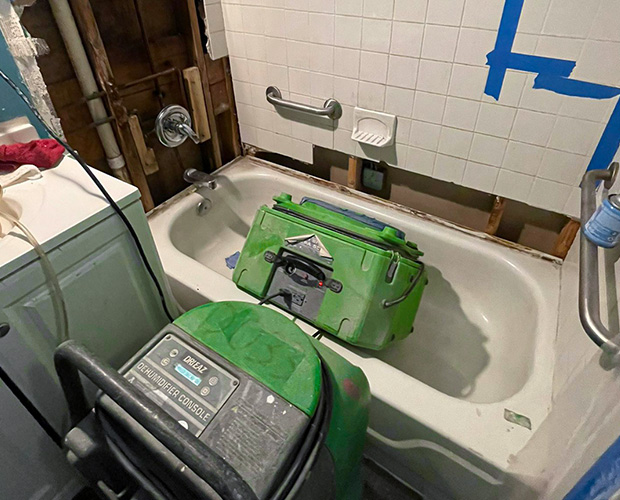
Structural bathroom mold — mold in the drywall, cement board, or timber framing behind the tile — requires professional remediation following IICRC S520 standards. This is not a cleaning job; it is a construction and remediation scope.
The S520 sequence for structural bathroom mold:
- Fix the moisture source (shower pan leak, grout failure, pipe leak behind the wall) — this step comes first and is non-negotiable
- Establish containment — poly sheeting and HEPA air scrubbers in negative pressure isolate the bathroom from the rest of the house during work
- Tile and fixture removal — tiles must come off to access the affected substrate and framing
- HEPA vacuum — all surfaces vacuumed before any disturbance
- Remove affected porous materials — drywall, cement board, and insulation that are mold-contaminated are removed and bagged; these cannot be treated in place per S520
- Inspect and treat framing — timber framing behind the wall is assessed; surface contamination is treated with antifungal and encapsulant; structural assessment if wood is compromised
- Dry to below 16% wood moisture content
- Reconstruct — new cement board, new tile, new waterproofing membrane (ideally upgraded from the original)
- Independent clearance testing
The cost for structural bathroom mold remediation involving drywall and framing removal typically falls in the $3,000–$8,000 range, depending on the extent of affected material and the market.
What Species of Mold Are Found in Bathrooms?
Species identification matters because it helps determine the risk level and the appropriate remediation scope:
- Cladosporium: The most common bathroom mold; appears on tile, grout, and caulk; a known allergen but not mycotoxigenic; surface treatment sufficient when contained to non-porous surfaces
- Penicillium/Aspergillus: Found on damp walls and ceiling materials; indicates moisture penetration beyond the tile surface; elevated indoor levels are a known allergen trigger and a hidden growth indicator
- Stachybotrys: Requires sustained moisture on cellulose materials for 8–12 days or more; if found on bathroom drywall or framing, indicates a long-term slow leak or shower pan failure; mycotoxin-producing; full S520 remediation required
- Chaetomium: Found on paper-faced drywall in chronically wet conditions; indicates persistent moisture behind the tile; structural remediation required
How Can You Prevent Bathroom Mold from Coming Back?
Prevention addresses the three conditions mold requires: moisture, food source, and warmth. In bathrooms, moisture is the lever you can control.
Ventilation: Install an exhaust fan sized for the room (calculate: length × width × height ÷ 7.5 = minimum CFM rating). Run it during every shower and for 10–15 minutes after. Check the duct terminates to the exterior — many older homes have bathroom fans that vent into the wall cavity or ceiling space, which deposits moisture into those spaces instead of removing it.
Squeegee habit: Wiping tiles and the shower door after use removes standing water from surfaces and dramatically reduces the moisture available for mold. This is a low-cost, high-impact prevention measure.
Caulk inspection: Inspect the caulk bead at the tub-wall junction and around the shower base annually. Any cracking, pulling away, or gap formation allows water to infiltrate behind the tile. Replace immediately rather than applying new caulk over old.
Grout sealing: Re-seal grout every two to three years with a penetrating silicone sealer. Unsealed grout is porous and absorbs moisture with every shower.
Frequently Asked Questions
How much does bathroom mold removal cost?
Surface mold (tile, grout, caulk) runs $500–$1,500 for professional antifungal treatment. Structural mold involving drywall and framing removal typically costs $3,000–$8,000. Add $400–$1,200 for an independent assessment and $400–$800 for clearance testing on structural jobs.
Can bathroom mold make you sick?
Cladosporium (common surface bathroom mold) is a known allergen that can trigger sneezing, runny nose, and eye irritation in sensitive individuals. Stachybotrys and Chaetomium (structural mold from chronic moisture) produce mycotoxins and are associated with more serious health effects. Anyone with respiratory conditions, asthma, or immune system compromise should be particularly cautious about mold exposure.
Is it safe to use a shower with visible mold?
Surface mold on tiles is a lower-risk situation, particularly if you are not mold-sensitive. However, if the mold persists after cleaning or is accompanied by a musty smell, do not assume it is surface-only. Consult a mold assessor before continuing regular use of the shower.
Will regrouting fix bathroom mold?
Regrouting resolves surface mold on grout lines, provided the substrate (the cement board or drywall behind the tile) is dry and sound. If moisture has penetrated behind the tiles — indicated by tile bounce, soft substrate, or persistent musty odour — regrouting will not fix the underlying problem and the mold will recur.
How long does bathroom mold remediation take?
Surface treatment: typically completed in one day. Structural remediation: two to five days for removal and treatment, plus drying time, plus reconstruction (a separate trade). Independent clearance testing adds another day and a 24–72 hour waiting period.
Is bathroom mold always black?
No. Cladosporium appears in shades of grey and green. Penicillium/Aspergillus is often blue-green or white. Stachybotrys is characteristically dark greenish-black and has a slimy texture when wet. Colour alone is not a reliable species identifier — laboratory sampling is required for definitive identification.