
Saltar al contenido
Remediación de moho licenciada — llame para agendar
EN
MoldAct logo MoldAct Remediación de Moho Certificada IICRC S520
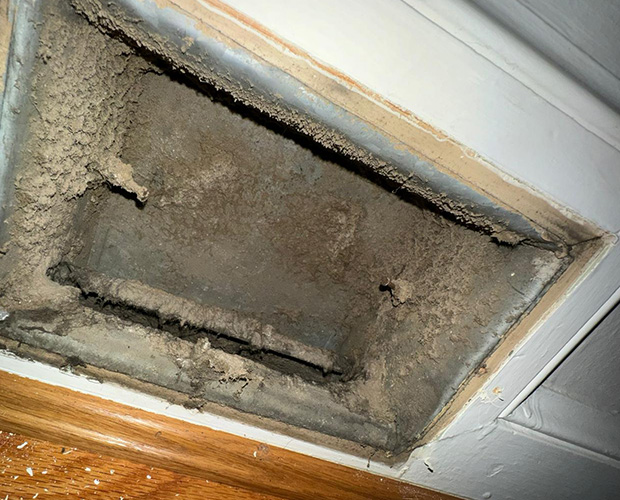
Mold buildup inside an aged HVAC unit's ductwork and components

Limpieza de Moho en HVAC en Miami

El moho en conductos de HVAC requiere remediación especializada — no simple limpieza de conductos — incluyendo tratamiento del serpentín del manejador de aire, desinfección de conductos y muestreo de control de calidad posterior.

Obtenga su Inspección de Moho Gratis

O llame ahora: (877) 660-0430

HVAC systems can harbour and distribute mold throughout an entire building. The air handler's evaporator coil and drain pan are the most common mold sites — condensate from the cooling process creates a continuously wet surface that supports Cladosporium, Penicillium, and in neglected systems, Stachybotrys. When the system runs, mold spores are drawn off these surfaces and distributed through the duct system to every room.

Routine duct cleaning (vacuuming the inside of ductwork) is not HVAC mold remediation. Duct cleaning removes accumulated dust and debris but does not address mold on the coil, drain pan, or inside the air handler itself. HVAC mold remediation requires treating the air handler as a mold-contaminated area, using EPA-registered antifungal agents on all interior surfaces, replacing the filter, and testing air quality after treatment with the system running.

HVAC mold is a particularly serious air quality issue because the system actively distributes spores. Any property with suspected HVAC mold should operate the system minimally until the assessment is complete and the remediation is performed.

Señales de que necesita moho en HVAC

  • Musty odour from supply vents when the HVAC system is running
  • Visible mold or dark staining inside the supply or return registers
  • Elevated mold spore counts in rooms that do not have visible mold on walls or ceilings
  • Allergy or respiratory symptoms that worsen when the HVAC is operating
  • Visible mold on the evaporator coil or in the air handler cabinet
  • Drain pan that is not draining (standing water in the condensate pan)

Por qué Miami lo sufre

Baltimore: central air conditioning in older Baltimore rowhouses is often retrofitted into attic or crawl-space air handlers with poorly sealed ductwork — condensate pan overflows and humidity infiltration into the duct system are common.

Miami: HVAC systems in Miami run almost continuously year-round to manage the tropical humidity. The high operational hours mean coil cleaning intervals are shorter and drain pan failures (due to algae growth blocking the condensate drain) are extremely common.

New Jersey: commercial buildings in Newark and Jersey City with older central HVAC systems commonly have deteriorated duct liner (fibreglass duct lining that has absorbed moisture) — a substrate that supports extensive Cladosporium and Aspergillus growth.

Simple, transparent process

Nuestro Proceso de Limpieza de Moho en HVAC

  1. 1

    System assessment

    The HVAC system is inspected at the air handler, coil, drain pan, plenum, supply ductwork, and return air path. A licensed mold assessor documents mold growth and moisture conditions. Air samples are collected with the system operating to assess spore delivery.

  2. 2

    System shutdown and containment

    The HVAC system is shut down before remediation begins. Where appropriate, supply registers are sealed to prevent cross-contamination during treatment.

  3. 3

    Coil and drain pan treatment

    The evaporator coil is treated with EPA-registered antifungal coil cleaner. The drain pan is cleaned, treated, and the condensate drain line is flushed and confirmed clear. A drain pan treatment tablet may be installed per the protocol.

  4. 4

    Air handler interior cleaning

    Interior surfaces of the air handler cabinet are HEPA-vacuumed and treated with EPA-registered antifungal. The filter is replaced with a MERV-13 rated filter.

  5. 5

    Duct interior treatment

    Accessible duct surfaces are HEPA-vacuumed and treated. For duct systems with confirmed mold growth, an EPA-registered encapsulant sealant may be applied to duct interior surfaces after cleaning.

  6. 6

    Post-remediation air quality sampling

    After treatment, the system is operated for a minimum of 30 minutes before clearance air samples are collected. Results confirm that the remediation reduced spore counts in supply air to acceptable levels before the system is returned to service.

Limpieza de Moho en HVAC — Preguntas Frecuentes

How often should HVAC coils be cleaned to prevent mold?

In humid climates (Miami, coastal NJ), annual coil cleaning is recommended. In temperate climates (Baltimore), biennial cleaning is typically sufficient. Condensate drain pans should be inspected and cleared at every service call.

Is it safe to run my HVAC if I think there is mold?

No — running a mold-contaminated HVAC system distributes spores throughout the building. Operate the system minimally until the assessment is complete. For properties with vulnerable occupants (asthma, immunocompromised), consider temporarily relocating until the system is cleared.

¿Necesita moho en HVAC en Miami?

Contratistas de remediación de moho certificados IICRC. Llame para agendar.

Llamar Cotización