
Saltar al contenido
Remediación de moho licenciada — llame para agendar
EN
MoldAct logo MoldAct Remediación de Moho Certificada IICRC S520
Mold growth along bathroom tile and grout caused by excess moisture and poor ventilation

Eliminación de Moho en Baño en Cockeysville

El moho en baños puede ser superficial (Cladosporium en azulejos) o estructural detrás de paredes — una evaluación profesional determina el alcance y si se necesita remoción de tablero de yeso o solo tratamiento de superficie.

Obtenga su Inspección de Moho Gratis

O llame ahora: (877) 660-0430

Moho en baño en Cockeysville: lo que debe saber

Si está en Cockeysville, está en una zona históricamente conocida por la extracción de piedra caliza y mármol — el mismo Mármol de Cockeysville usado en el Monumento a Washington y el Capitolio de EE.UU. — y esa geología caliza subyacente crea condiciones tipo karst en algunos lugares, donde el agua subterránea puede moverse por canales naturales en la roca de forma que no siempre sigue el drenaje superficial esperado.

Si su sótano se inunda de una manera que no coincide con los problemas obvios de nivelación o canalones, vale la pena preguntar si la geología caliza local está dirigiendo el agua subterránea de forma diferente a lo que predeciría una evaluación estándar de drenaje del suelo.

Condiciones de moho en Cockeysville

Tipos de moho comunes en esta zona: Stachybotrys chartarum (irregular groundwater movement through limestone/karst geology); Cladosporium (older farmhouse and mid-century foundation drainage); Penicillium/Aspergillus (newer suburban HVAC and interior humidity); Chaetomium (long-standing moisture in older agricultural-era buildings).

Señales de que necesita moho en baño

  • Black or greenish mould visible on grout lines, caulk, or tile surfaces
  • Soft or spongy drywall at the base of the shower or bath surround
  • Bubbling, cracked, or loose tiles — often indicating moisture migration behind
  • Persistent musty odour in the bathroom after surface cleaning
  • Staining on the ceiling below a bathroom (mold in subfloor or hidden leak)
  • Visible mold at the base of toilet, vanity, or around plumbing penetrations
Simple, transparent process

Nuestro Proceso de Eliminación de Moho en Baño en Cockeysville

  1. 1

    Surface vs. structural assessment

    The assessor uses a moisture meter and, if needed, thermal imaging to determine whether moisture has penetrated behind the tile surface. Probe holes or exploratory opening may be specified to confirm the extent.

  2. 2

    Surface mold treatment (if applicable)

    Surface mold on non-porous tile and sealed grout is treated with EPA-registered antifungal agents, HEPA-vacuumed, and recaulked. This is not a remediation — it is maintenance cleaning appropriate only when the tile assembly is confirmed intact and the moisture source is controlled.

  3. 3

    Structural remediation (if required)

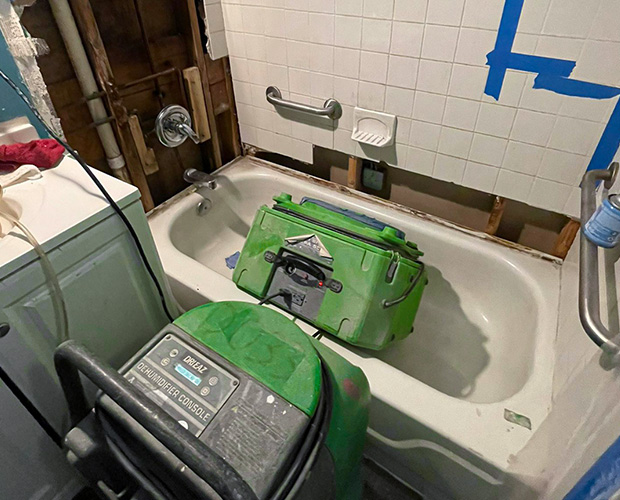
    Affected tile and drywall are removed to expose the framing. Mold on studs and blocking is treated per the IICRC S520 protocol. Subfloor damage is assessed and replaced if moisture-compromised. Containment is maintained to prevent spore spread to adjacent areas.

  4. 4

    Exhaust ventilation correction

    Bathroom exhaust fans are inspected and tested. Undersized or non-functioning fans are replaced with fans rated for the room volume (HVI-certified). Exhaust ducting is confirmed to terminate outside the building envelope.

  5. 5

    Reconstruction and clearance

    After clearance testing, the bathroom is rebuilt with cement board or moisture-resistant substrate, waterproofing membrane at wet areas, and properly sealed tile installation. A clearance report documents that the remediation met IICRC standards.

Eliminación de Moho en Baño en Cockeysville — Preguntas Frecuentes

¿Proporcionan moho en baño en Cockeysville?

Sí — MoldAct proporciona moho en baño en Cockeysville (códigos postales: 21030). Llámenos para programar la cita disponible más cercana.

Can I remove bathroom mold with bleach?

Bleach kills surface mold on non-porous surfaces only. It does not penetrate grout or caulk effectively, does not treat mold on porous materials like drywall, and does not remove the dead mold or its allergens. For structural mold, bleach is not appropriate and may produce harmful fumes in a confined space.

How do I prevent mold from coming back in my bathroom?

Run the exhaust fan for at least 20–30 minutes after every shower, maintain grout and caulk sealing annually, wipe down shower surfaces after use, and maintain relative humidity below 60% with air conditioning or dehumidification. Condensation on cold surfaces is a key warning sign of inadequate ventilation.

Eliminación de Moho en Baño en Cockeysville — reserve hoy

Contratistas de remediación de moho certificados IICRC. Llame para agendar.

Llamar Cotización